
 admin
admin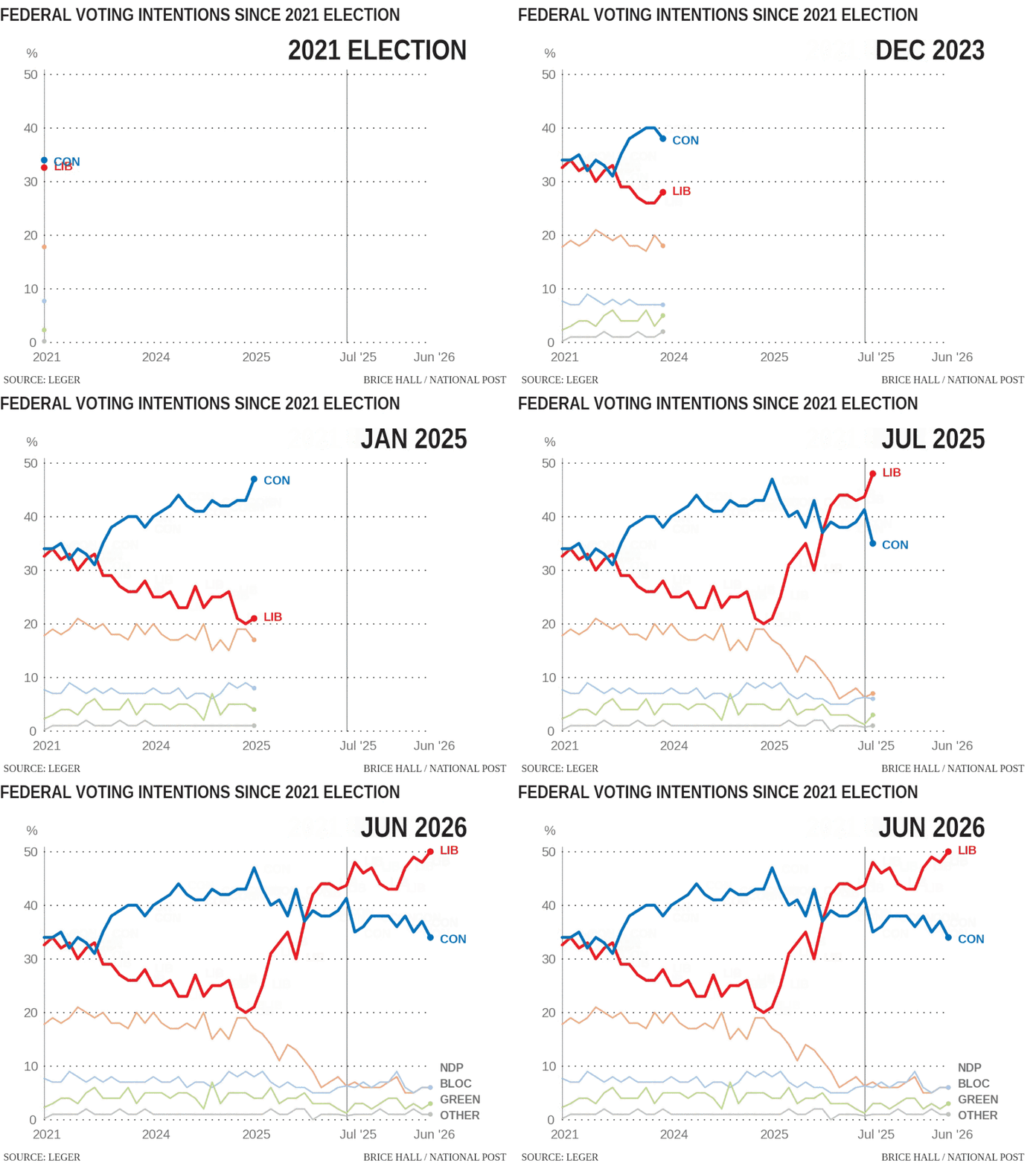
OTTAWA — The Carney Liberals now have the support of half of all Canadians, according to a new Postmedia-Leger poll, the first time any governing party has hit that benchmark in popular support in more than two decades.
Article content
The poll, conducted over the last week, found that 50 per cent of decided voters said that they would most likely support the Liberals “if federal elections were held today.”
Article content
Article content
Article content
The poll found that the Conservatives have the support of 34 per cent of Canadians, down three percentage points from April. Both the New Democrats and Bloc Quebecois are at six per cent support, the same as the previous month, with the Green Party at three per cent, up one percentage point.
Article content
Article content
The percentage of Canadians who now say they’d likely support one of the two major parties is almost identical to the historically high 85.1 per cent who did so during the last federal election when the dominant issue was how Canada should respond to the trade and sovereignty threats of U.S. President Donald Trump.
Article content
The big change over the last 16 months, however, has been a clear transfer of a significant chunk — about seven percentage points — of Conservative support from last April to the governing Liberals.
Article content
Andrew Enns, Leger’s executive vice-president, said no Canadian government has topped 50 per cent in support since 2003, when Prime Minister Jean Chrétien decided that Canada would not take part in the U.S.-led invasion of Iraq in March of that year without a United Nations Security Council resolution.
Article content
Article content
Enns said the 50-per-cent mark is only a couple of percentage points above where Carney’s Liberals have polled in recent months, but that it represents a watershed because it’s rare, an important psychological hurdle, and represents “a real majority.
Article content
Read More
- Time to move past Trump’s tariffs and focus on boosting growth, Chamber of Commerce tells Liberals
- Pierre Poilievre needs a historic comeback — here’s how he can do it
Article content
“That’s a big number,” said Enns. “We just don’t see it often in Canada.”
Article content
But Enns noted that Justin Trudeau’s Liberals also came close at one point during their first mandate to winning the support of half of the country when they reached 49 per cent in the polls in 2016.
Article content
The new poll shows that the Liberals have sturdy support across the country and among most key demographic groups, but the government is particularly strong in Atlantic Canada (62 per cent), British Columbia (56 per cent), and with Canadians over the age of 55 (59 per cent). Carney’s party is weakest, as has often been the case in recent decades, in Manitoba-Saskatchewan (31 per cent) and Alberta (36 per cent).
Article content
Support for the government was largely consistent among men (48 per cent) and women (52 per cent), and among urban (52 per cent), suburban (49 per cent) and rural (45 per cent) voters.
Trending
- Is the Citizen restaurant critic out of touch with diners’ palates?
- Early retirement incentives to reduce department operating budgets
- Two new swimming docks coming to the Ottawa River this summer
- New Ottawa café makes decadent street food from Brazil
- Bank and Leitrim is a ‘mess’ and these residents can’t wait for its new design
Article content
A majority of respondents (54 per cent) also said they were either “very satisfied” (15 per cent) or “somewhat satisfied” (40 per cent) with the Carney government, with 37 per cent saying they were either “somewhat dissatisfied” (17 per cent) or “very dissatisfied” (20 per cent). That number of “satisfied” respondents is down between three and five percentage points from earlier months this year.
Article content
As for the prime minister himself, the poll found that Carney has an approval rating of 56 per cent, down three percentage points from a month earlier. He has a disapproval rating of 34 per cent, compared to 33 per cent in April.
Article content
With the Liberals now holding a parliamentary majority after benefitting from recent byelection wins and a handful of floor crossers (four from the Conservatives, one from the New Democrats), the next election isn’t expected to be held for another few years. But opinion poll results always play a significant role in politics, and these numbers may strengthen Carney’s hand, for example, in dealings with provinces. They may also raise fresh strategic questions for the opposition parties, particularly the Conservatives and their leader Pierre Poilievre.
Article content
The poll sampled 1,532 Canadians over the age of 18 between May 29 and June 1. A probability sample of this size yields a margin of error that is no greater than 2.5 per cent, 19 times out of 20.